
How US Firms Are Replacing Hiring with Global Capacity Models | Intellgus
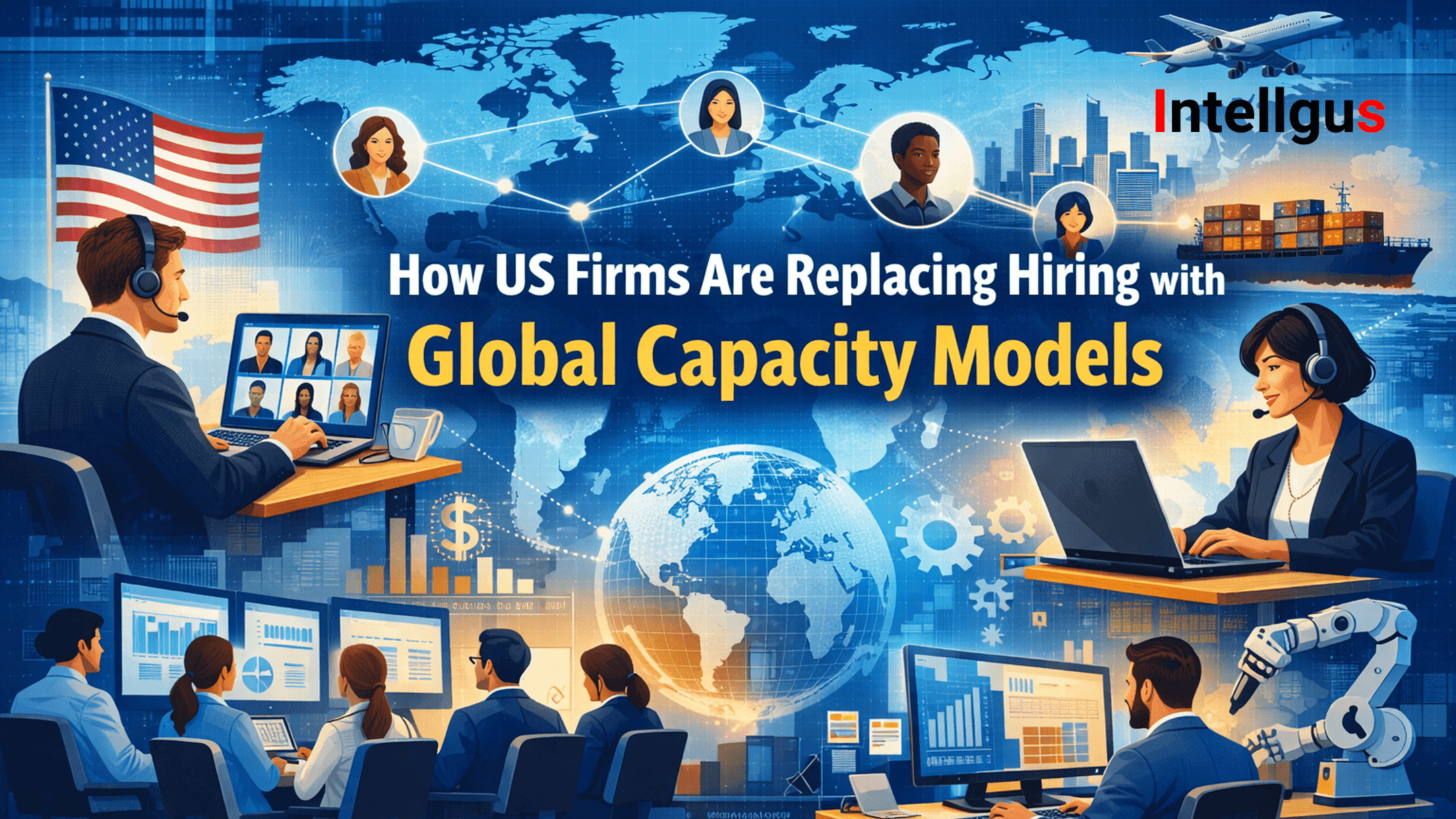
For decades, growth in US firms meant one thing: hire more people. More clients required more staff, which meant longer recruitment cycles, higher payroll costs, and increasing operational complexity.
But in 2026, that traditional model is breaking. Instead of expanding headcount, forward-thinking firms are expanding capacity — through global delivery models.
The shift is subtle but powerful. Firms are no longer asking, “Who should we hire?” They’re asking, “How can we scale without increasing fixed costs?”
The Hiring Bottleneck Is Slowing Growth
Across accounting and advisory sectors, firms are facing prolonged hiring cycles, rising salary expectations, and talent shortages. Experienced professionals are harder to find, onboarding takes months, and retention remains uncertain.
Every new hire increases fixed overhead — salaries, benefits, training, compliance costs, and infrastructure. When workload fluctuates seasonally, these fixed costs remain constant, compressing margins during slower periods.
This is where the global capacity model changes the equation.
From Headcount to Capacity
A global capacity model shifts focus from “people” to “output.” Instead of hiring full-time employees locally, firms build structured offshore or distributed teams that integrate into their workflows.
The goal is not simply cost reduction. It is operational elasticity.
With global capacity support, firms can:
Scale during peak tax and audit seasons
Reduce turnaround time
Improve workflow consistency
Maintain margins without overextending internal teams
This model transforms staffing from a rigid structure into a flexible system.
Why Global Capacity Models Work
Technology has removed geographical barriers. Cloud accounting platforms, secure document management systems, and workflow automation tools allow distributed teams to collaborate seamlessly.
More importantly, structured global support reduces dependency on unpredictable hiring markets. Instead of competing for scarce local talent, firms tap into trained global professionals aligned with standardized processes.
The result is improved predictability. Firms know their delivery timelines, cost structures, and operational capacity with far greater clarity.
The Margin Advantage
Traditional hiring increases revenue and expenses simultaneously. Global capacity models increase revenue potential while controlling cost escalation.
When managed strategically, this creates a margin gap between firms that rely purely on local hiring and firms that operate with blended global teams.
Over time, that margin advantage compounds.
Beyond Cost — Strategic Focus
Perhaps the most overlooked benefit is leadership focus. When partners are not constantly recruiting, onboarding, and troubleshooting staffing shortages, they can concentrate on client advisory, growth strategy, and relationship building.
Capacity becomes an enabler, not a constraint.
The Future of Firm Scaling
The firms that will dominate the next five years are not necessarily the largest — they are the most operationally intelligent.
They understand that growth is not about adding bodies. It is about designing systems that scale.
At Intellgus, we help US firms build structured global capacity models that integrate seamlessly with existing workflows. Our approach is process-driven, security-focused, and built for long-term operational stability — not short-term patchwork solutions.
The question is no longer whether global capacity works.
The real question is whether your firm is prepared to compete with those who are already using it.




Leave a Comment