
Outsourced Accounting Cost 2026: Full Pricing Guide + ROI Calculator
Quick Answer
Outsourced accounting typically costs $500–$3,000/month for a small business handling basic bookkeeping, and $5,000–$20,000+/month for a mid-sized company needing a full accounting department with controller and CFO-level oversight. Actual price depends on transaction volume, service scope, and whether the provider prices hourly, per-employee, or as a flat monthly fee.
Table of Contents
What Outsourced Accounting Actually Costs in 2026
Pricing Models Explained
What Drives Your Price Up or Down
The Intellgus Hidden Cost Matrix™
Cost by Business Type (Illustrative Scenarios)
In-House vs. Outsourced: The Real Math
How to Calculate Your ROI
FAQs
1. What Outsourced Accounting Actually Costs in 2026
The market has consolidated around a few clear pricing bands:
Service levelTypical monthly rangeBest fitBasic bookkeeping$250 – $1,500Solopreneurs, pre-revenue startupsBookkeeping + controller oversight$1,500 – $5,000Small businesses, 50–300 transactions/moFull accounting department (AP/AR, reporting, compliance)$5,000 – $12,000Growing SMEs, multi-entity businessesFull-service + fractional CFO$8,000 – $20,000+Scaling companies, funded startups
Hourly-billed engagements generally land between $50–$175/hour for US-based providers, and considerably lower for fully-loaded offshore engagements, where the quoted rate already bundles salary, HR, IT, security compliance, and management overhead — no separate line items for benefits or equipment.
Why the range is so wide: providers aren't disagreeing on value — they're pricing different bundles. A $600/month quote and an $8,000/month quote can both be "outsourced accounting"; one is transaction processing, the other is a finance department.
2. Pricing Models Explained
ModelHow it worksWatch out forFlat monthlyFixed fee for a defined scopeScope creep once transaction volume growsHourlyBilled per hour workedInvoices that "creep up" with no volume changePer-employee/per-transactionPriced by headcount or transaction countCan spike unpredictably during growthProject-basedFixed price for a defined deliverable (e.g., cleanup, audit prep)Often priced higher per-unit, but no ongoing commitmentHybridBase retainer + variable usage feesRead the fine print on what triggers the variable charge
3. What Drives Your Price Up or Down
Monthly transaction volume
Number of bank/credit accounts and entities
Payroll complexity and headcount
Whether you need AP/AR management, not just bookkeeping
Compliance requirements (GAAP reporting, SOC 2, HIPAA for healthcare clients)
ERP/software stack (QuickBooks vs. NetSuite vs. Oracle/SAP integrations cost more to support)
Reporting cadence (monthly close vs. real-time dashboards)
Industry complexity (law firm trust accounting and manufacturing COGS tracking both add cost)
4. The Intellgus Hidden Cost Matrix™
Most pricing pages quote the entry price. The real 12-month cost is usually higher once these are added:
Hidden costTypical triggerRough impactCatch-up/cleanup feesMessy prior-year books+1–3 months of standard fee, one-timeSoftware subscription pass-throughProvider requires specific tools+$50–$300/monthYear-end bundle feeTax-season close and 1099/W-2 prep+$500–$2,000, one-timeOverage feesExceeding contracted transaction volumeVariable, often uncappedOnboarding/setup feeNew engagements$500–$2,500, one-time
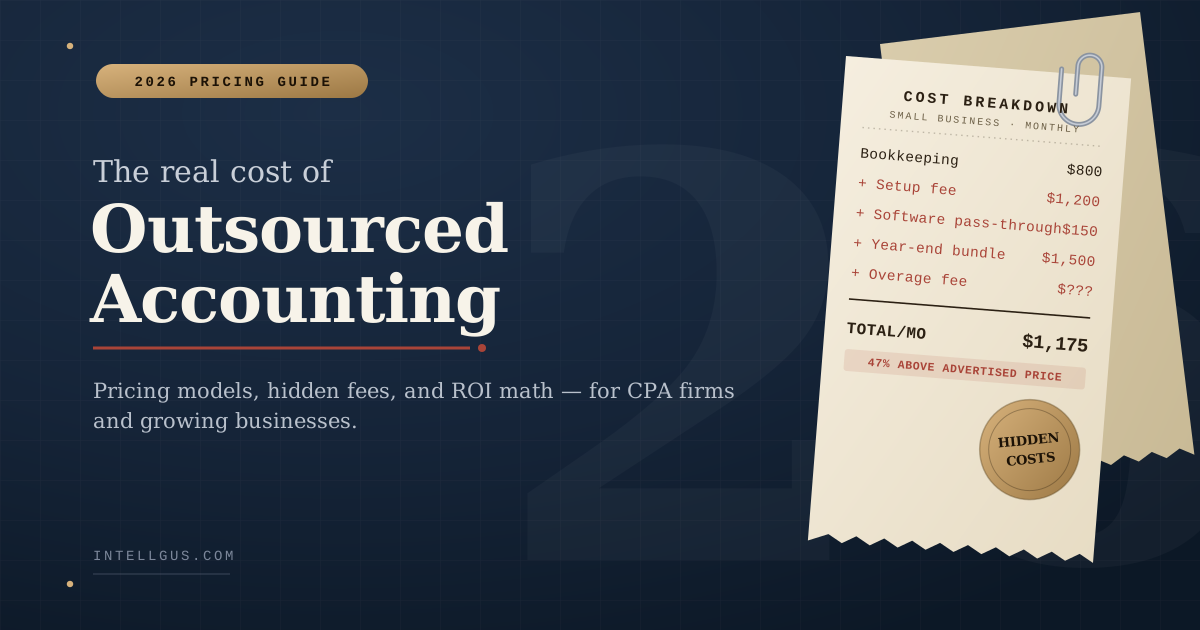
Illustrative Example: A provider advertises "$800/month bookkeeping." After a $1,200 onboarding fee, a $150/month software pass-through, and a $1,500 year-end bundle, the effective first-year monthly cost is closer to $1,175/month — roughly 47% above the advertised entry price. This is a hypothetical illustration, not a benchmark for any specific provider.
5. Cost by Business Type (Illustrative Scenarios)
These are sample calculations built on stated assumptions — not published industry statistics.

6. In-House vs. Outsourced: The Real Math
Illustrative scenario — small business, ~150 transactions/month:
 This is a sample calculation using stated assumptions (one FTE bookkeeper, standard benefits load); actual savings vary by role, region, and scope.
7. How to Calculate Your ROI
A simple framework:
ROI = (In-house fully-loaded cost − Outsourced cost) / Outsourced cost × 100Inputs to gather:
Fully-loaded in-house cost (salary + benefits + payroll tax + software + turnover risk)
Outsourced quote (all-in, including likely add-ons from the Hidden Cost Matrix above)
Time-to-value (how fast the outsourced team can close your books vs. current state)
Break-even typically happens within the first billing cycle for businesses currently overpaying for underused in-house capacity — but run your own numbers, since scope and geography materially change the equation.
Ready to see what outsourced accounting would actually cost for your business? [Request a custom quote from Intellgus] — no obligation, transparent pricing, no hidden bundles.
Frequently Asked Questions
For most businesses under roughly $5M in revenue, yes — outsourcing usually costs 20–50% less than a fully-loaded in-house hire once benefits, payroll tax, software, and turnover risk are factored in. Above that revenue level, the math depends heavily on complexity and scope.
Hourly pricing suits variable or project-based work; flat monthly pricing suits businesses with consistent, predictable transaction volume and want budget certainty.
Usually catch-up fees, software pass-throughs, year-end bundles, or exceeding your contracted transaction volume — all of which should be disclosed upfront by a transparent provider.
Most established providers integrate with common platforms (QuickBooks, Xero, NetSuite; enterprise-tier providers also support Oracle/SAP), though integration depth and cost vary by provider and system


Leave a Comment